THE STAT
The Total Offense College Football Definition and How It Alters Player Records
Fourteen desk1263 wordsQuarterbacks
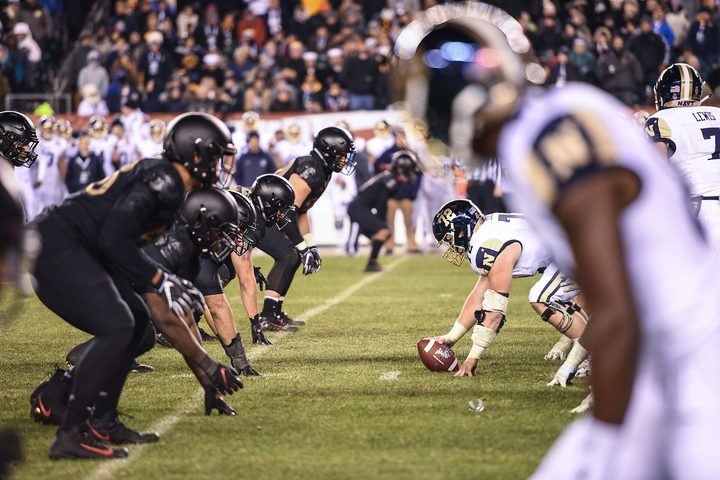
Foto: U.S. Department of Defense Current Photos / Wikimedia Commons · Public domain
Under the NCAA Football Statisticians’ Manual, total offense is defined as the combined result of rushing and forward passing only, calculated as the total of net gain rushing and net gain forward passing. Because collegiate bookkeeping logs lost yardage on sacks as negative rushing yardage, every tackle behind the line of scrimmage on an attempted pass reduces a quarterback’s individual total offense ledger.
Box scores display this composite number alongside standard passing yardage, often generating confusion when a passer's total offense lags behind their aerial yardage. The gap comes down to statutory accounting. The metric tracks only the two legal ways an offensive player can advance the football from scrimmage while retaining team possession. By merging passing output with net ground production, college record books generate a number that diverges from professional ledgers.
The Net Arithmetic of Forward Passes and Rushes
The NCAA total offense college football definition operates within strict statutory borders. The official manual restricts the tally to rushing and forward passing.
Receiving yards do not exist within this calculation. A wide receiver who gains 150 yards on six receptions finishes the afternoon with zero yards of total offense, provided that receiver never attempted a forward pass or took a direct handoff on a rushing attempt. Runback yards are excluded as well. Kickoff returns, punt runbacks, and interception returns belong to distinct categories outside the total offense ledger.
The governing principle rests on individual control and advancement from scrimmage. According to the NCAA manual, total offense covers only the two legal methods an individual uses to advance the ball while retaining team possession. If an athlete runs the ball from scrimmage, the yardage gained belongs to rushing. If the athlete throws a forward pass, the yards gained on the play belong to passing. Total offense merely pools those two net sums together into an aggregate number.
Net is the operative term. The NCAA manual dictates that rushing yardage is measured from the line of scrimmage to the point where the ball becomes dead. When a runner is brought down behind that line of scrimmage, all rushing losses must be recorded so as to account for the net figure.
If a quarterback throws for 300 yards, gains 20 yards on two designed scrambles, but loses 35 yards across three sacks, the arithmetic adjusts immediately. The rushing column registers minus 15 net yards. Combined with the 300 yards through the air, the quarterback's final total offense stands at 285 yards. Gross gains never override negative plays in the NCAA statistical framework.
How Sacks Drag Down College Yardage Ledgers
Sacks represent the single largest structural divide between collegiate and professional offensive statistics. In college football, when a quarterback is tackled behind the line of scrimmage while looking downfield to pass, the yardage lost is categorized as negative rushing yardage charged against that quarterback.
This classification directly suppresses the player's rushing total and, by extension, their overall total offense. A college quarterback operating behind an unstable offensive line can throw for high yardage totals yet finish with a deflated total offense number due to repeated sacks.
Because the NCAA treats sack yardage as a rushing loss, the statistical burden falls squarely on the individual passer's rushing ledger. The NCAA framework requires all rushing losses to be compiled against gross rushing gains to establish the final net rushing baseline. When sacks accumulate, that baseline drops into negative territory.
The result is a metric that reflects individual ball progression subtracted by every dropback failure that ends in a tackle behind the line.
The NFL Division Between Passing and Sack Yardage
Professional football handles these same plays under an entirely different bookkeeping standard. The NFL Guide for Statisticians, updated in 2026, outlines an approach that separates quarterback sacks from individual rushing totals.
The NFL Guide for Statisticians specifies that passing yardage includes the length of the pass plus the running yardage gained or lost by the receiver after the completion. When a play breaks down behind the line, the NFL uses a dedicated classification. The league's guide establishes a separate category called "sacks and yards lost attempting to pass."
Under NFL scoring rules, a play is scored as a sack when the quarterback or a teammate makes an apparent attempt to pass before being tackled, stepping out of bounds, or fumbling behind or at the statistical line of scrimmage. If the passer fumbles behind the line while attempting to pass, the play is charged as a sack, and all lost yardage is entered into the records as yards lost attempting to pass.
The NFL manual draws a distinct boundary regarding when a pass attempt converts into a running play. If the passer advances the ball across the statistical line of scrimmage, the play is classified as a rushing attempt. Behind the line, however, an apparent attempt to pass that results in lost yardage remains strictly within the sack category.
Crucially, the NFL does not subtract sack yardage from the quarterback's individual rushing yardage totals. Nor does it subtract sack yardage from the passer's individual passing yards. Instead, the NFL tracks sack yardage lost as a distinct metric that subtracts from the team's net passing total, leaving the individual passer's gross passing and rushing tallies untouched by sack yardage.
Why Player Profiles Diverge Across Record Books
This difference in accounting means a quarterback's statistical profile in college cannot be placed directly against an NFL ledger without understanding the baseline mechanics.
Consider a player who throws for 3,500 yards in a single college season while generating 400 positive rushing yards, but suffers 300 yards in losses from sacks. In the NCAA ledger, that player's net rushing yardage is officially recorded as 100 yards. The player's total offense finishes at 3,600 yards.
Transfer that exact performance into the NFL bookkeeping system. The player retains the 3,500 individual passing yards and the 400 individual rushing yards. The 300 yards lost on sacks are isolated into the separate sack category. The resulting individual numbers present a 3,500-yard passer with 400 rushing yards, presenting a statistical picture of a much more productive runner than the college box score suggests.
The NCAA framework creates a hybrid individual number that penalizes the passer for protection failures. Dual-threat passers who run frequently can mask sack losses if their positive ground yardage outpaces their negative plays behind the line. For traditional pocket passers who rarely run downfield, sack losses simply chip away at their total offense, often leaving them with negative career rushing figures that drag their career total offense below their career passing yardage.
Boundary Lines in the College Box Score
The exclusion of receiving and return yardage ensures that total offense remains an exclusive domain for passers and primary ball-carriers. A running back who gains 80 rushing yards and 80 receiving yards will see only the 80 rushing yards entered into their total offense column.
The metric was never designed to show all-purpose yardage. It reflects only the direct movement of the ball via a handoff, a scramble, or a forward throw. The NCAA manual’s boundary on this point is firm: total offense measures the net gain of rushing and the net gain of forward passing, and nothing else.
When analyzing college football record books, total offense serves as a record of individual yardage creation from scrimmage under strict net rules. A high total offense number confirms that a player produced substantial net yardage through the air and on the ground. A total offense figure that falls below a player's passing yardage confirms that collegiate scorekeepers subtracted every sack directly from the quarterback's personal balance sheet.