THE SYSTEM
The Run-Pass Option and the One-Yard Rule Governing It
Fourteen desk1097 wordsQuarterbacks
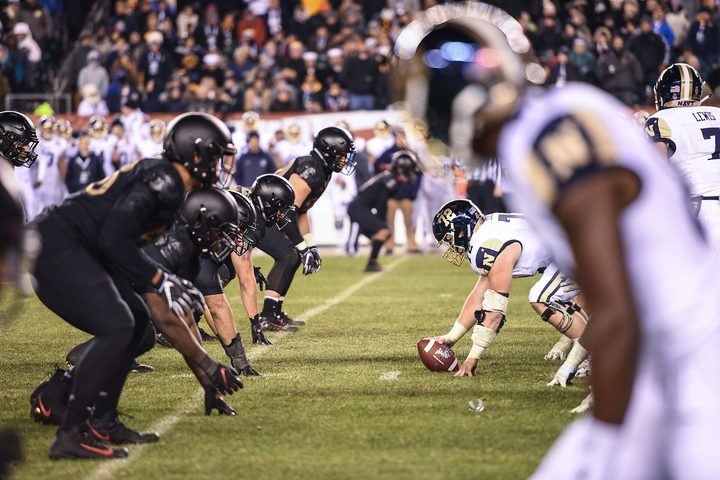
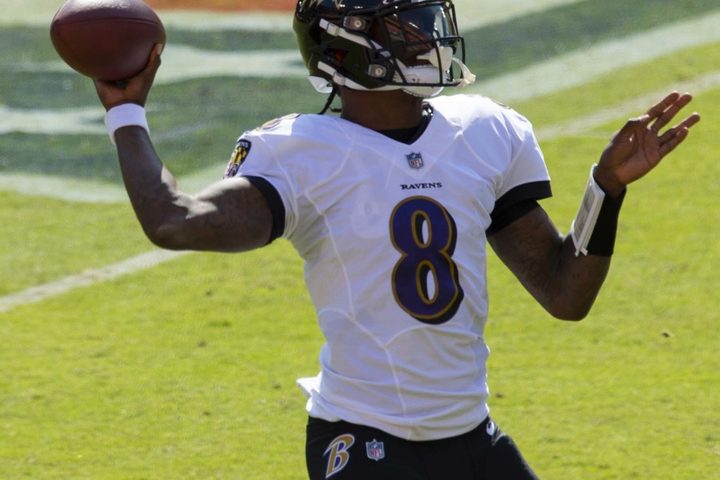
Foto: U.S. Department of Defense Current Photos / Wikimedia Commons · Public domain
Under the official playing rules published by NFL Football Operations, an ineligible offensive player commits a foul if his entire body is more than one yard beyond the line of scrimmage before a forward pass is thrown. That single yard defines the modern run-pass option. The run-pass option (RPO) that football coaches diagram on greaseboards operates inside that physical perimeter, forcing the quarterback to make a live post-snap choice before an advancing lineman triggers a five-yard penalty.
Every scrimmage down with a forward pass carries this spatial clock. If an offense executes a pure running play, interior linemen can drive defenders ten yards down the field without consequence. When a forward pass is introduced, those same linemen are tethered to the neutral zone. Because the concept deliberately pairs a forward-charging run block with a downfield route, the ball must leave the passer's hands before those linemen cross the one-yard boundary.
Two Plays Packaged at the Snap
Football Nation USA defines an RPO as a scheme where the quarterback reads a designated defender and decides whether to hand off or throw after the snap. In an analysis dated 2026-06-16, NFL Analytics described the concept as one single snap containing two plays, a run and a pass packaged together.
The mechanics rely on immediate post-snap distribution. In an entry dated 2024-12-13, the sports betting glossary on RG.org explained that the quarterback evaluates the defense after the snap to decide between handing the ball to a runner, keeping it to run, or throwing to an open target.
The running back takes an aggressive path toward the interior gap. The offensive line fires forward as if the call is an ordinary handoff. If the selected defender steps toward the line to plug the run, the quarterback pulls the ball back and targets a receiver filling the space that defender vacated.
If that same defender drops back to cover the passing lane, the quarterback places the ball into the belly of the running back. Two outcomes remain live while the ball is in the mesh point.
The Line Between Play-Action Fakes and Post-Snap Reads
Play action and the run-pass option look similar from the grandstand, but they function on opposing operating principles. According to Football Nation USA, play action is a designed pass from the start that begins by convincing the defense a run is coming.
In standard play action, the quarterback and running back stage a choreographed fake handoff. The offensive line and eligible receivers present a run picture to freeze the linebackers, but the decision to pass was decided in the huddle before the team broke to the line. The running back cannot actually take the ball. The quarterback will not let him have it.
An RPO eliminates that predetermination. As Football Nation USA documented in an article dated 2026-08-15, the quarterback on an RPO makes a real-time choice based entirely on the post-snap movement of an isolated defender. The give to the running back is a genuine run. The throw to the perimeter is a genuine pass.
That structural difference creates distinct demands on the offensive line. During traditional play action, linemen can set up in pass protection or simulate a momentary run block before retreating to protect the pocket. On an RPO, the linemen must fire into contact to sell the running phase, which means they are pushing downfield from the opening split-second of the play.
Ineligible Receiver Limits and the Five-Yard Clock
The entire concept functions under strict personnel definitions. NFL Football Operations defines an ineligible receiver as any player who cannot legally catch a forward pass.
Under the NFL video rulebook, players who are not positioned on either end of the line of scrimmage or positioned at least one yard behind it when the ball is snapped are ineligible to catch a forward pass thrown from behind the neutral zone. Interior offensive linemen—centers, guards, and tackles—fall squarely into this category by alignment.
Receivers must also maintain their legal status throughout the snap. The NFL video rulebook specifies that an eligible receiver who steps out of bounds prior to or during a forward pass becomes ineligible. He cannot regain eligibility to touch the ball even if he re-establishes himself inbounds with both feet or any part of his body other than his hands.
When an ineligible lineman strays too far, the whistle blows. The 2023 PDF edition of the NFL rulebook, last updated 2026-05-04, sets the enforcement standard:
- The foul occurs when an ineligible player's entire body passes more than one yard beyond the line of scrimmage before the pass is thrown.
- The penalty costs the offense five yards, measured from the previous spot.
- The restriction remains active until a forward pass is released or crosses the line of scrimmage.
A Wikipedia entry on ineligible receivers downfield, last updated 2026-09-23, outlines the split between playing levels. While the NFL enforces a strict one-yard limit, college football allows offensive linemen a three-yard buffer past the line of scrimmage before penalizing them five yards. That extra two yards at the collegiate level gives the quarterback more time to read the defense, whereas NFL passers must release the ball instantly.
Reading the Designated Defender Under Pressure
The quarterback's pre-snap process isolates one defender who is intentionally left unblocked. NFL Analytics and Football Nation USA both emphasize that the quarterback does not scan the entire defensive secondary; he fixes his eyes on that single designated player.
The read happens in a fraction of a second. As the center snaps the ball, the quarterback watches the defender's first step. A downhill movement toward the line of scrimmage triggers an immediate throw behind him. A hesitation or backward retreat hands the ball off to the running back against a depleted defensive front.
Linemen surging forward will cross that 36-inch boundary within roughly two seconds. If the quarterback hesitates or holds the ball too long while reading the defense, his left guard or center will inevitably cross the one-yard threshold, drawing an illegal downfield penalty from the officiating crew.
Offenses cannot run vertical, slow-developing pass patterns off these looks. The pass route attached to an RPO must break instantly into the vacated area, because the offensive line is blocking an active run rather than holding a pass-blocking pocket.
The regulatory margin leaves zero room for error. The 2023 NFL rulebook update makes clear that an ineligible player's full body position at the moment the ball is thrown determines whether the play stands or loses five yards. When the line pushes forward, the quarterback either throws immediately or relinquishes the football to the ground attack.